What it does, and what it costs to do it.
Every number on this page was measured on a real asset during the work that produced it. Where something has a limit, it is written down here rather than discovered later.
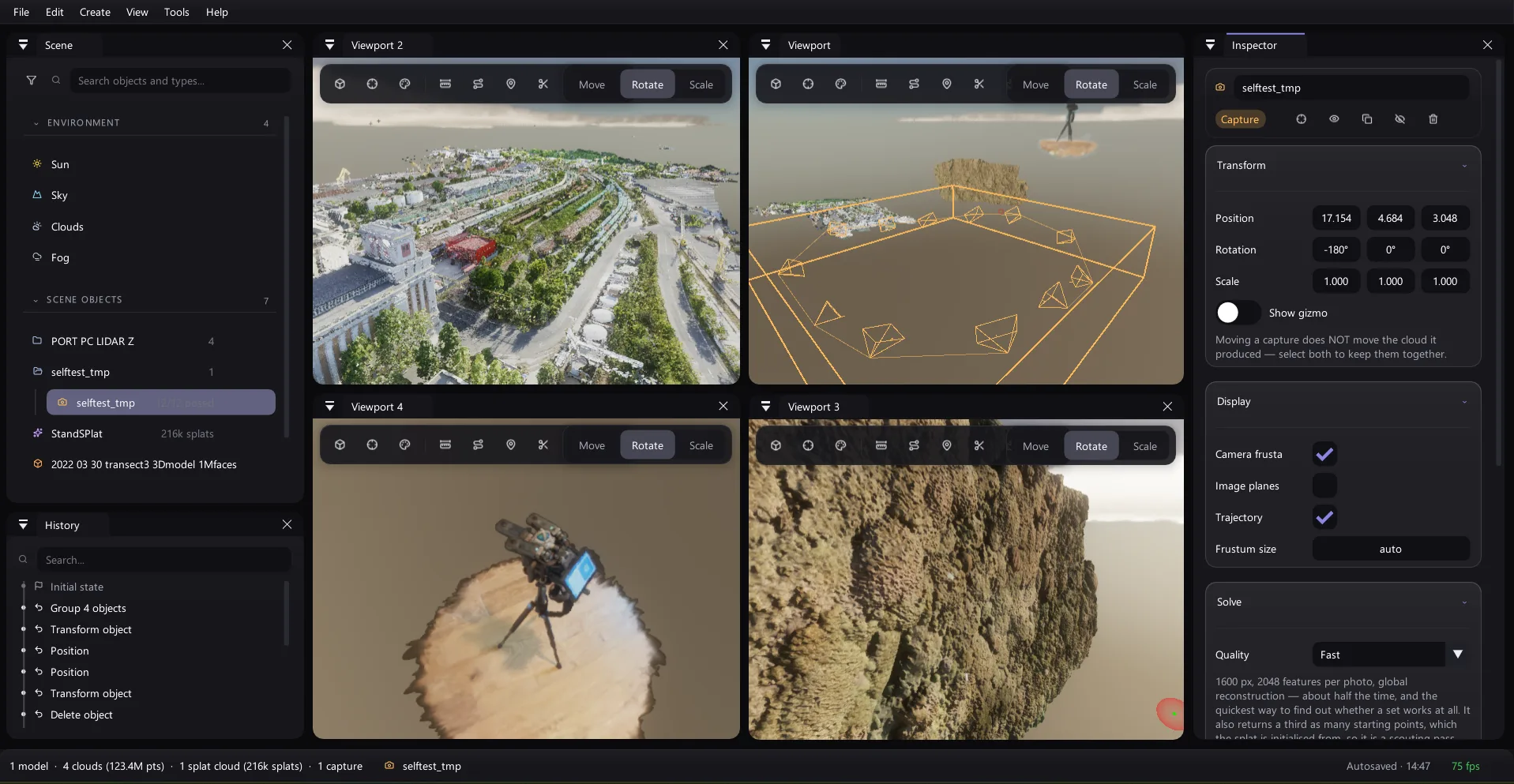
Multi-gigabyte geometry, in real time, on a modest GPU.
A big scan is cooked once into a cluster-level-of-detail graph — a hierarchy where every level is a correct, watertight version of the whole model — and then the renderer picks the cut that this frame's camera deserves, in two compute dispatches, and draws it in one call.
- It opens. The importer streams: an 81.8-million triangle, 9.18 GB OBJ reads in about 1 GB of private memory instead of the 30–50 GB a naive parser needs.
- It stays open. Cluster pages stream in on demand and the coldest are evicted, so VRAM use is a budget you choose.
- Cook once, open instantly after. The cache sits beside the file; opening it a second time is a memory-map, and you can manage or delete every cache from Settings.
- Still a normal object. Pick it, snap to it, measure it, ray-trace it, export it back out — a virtualized mesh is a representation, not a second class of thing.
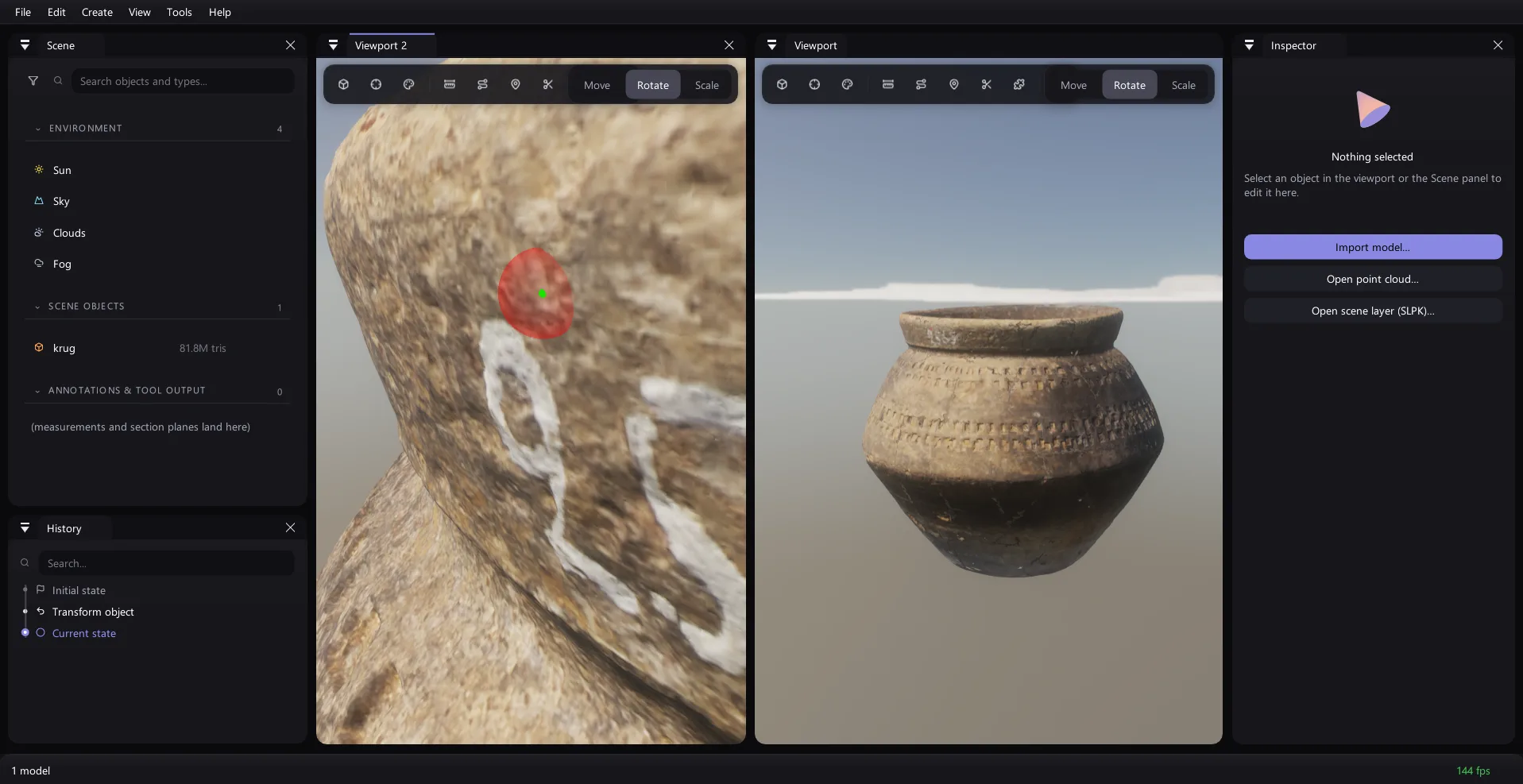
Photographs in, Gaussian splats out.
Three steps, all local: photographs, camera poses, splat cloud. Each intermediate result is a real object in the scene you can look at, switch on and off, save and export — not a hidden stage in a pipeline.
- The solver installs itself. One button fetches the official build and puts it in your user folder. Nothing to redistribute, nothing to configure, and you can delete it again.
- Poses you can walk into. Solved cameras appear as frusta on the overlay; click one to fly the viewport to that photograph’s exact viewpoint.
- Training on your GPU, as compute shaders on core Vulkan — no CUDA, so it is not an NVIDIA-only feature.
- Export to anything downstream. COLMAP binary or text, nerfstudio transforms.json, and splats as PLY or SPZ.
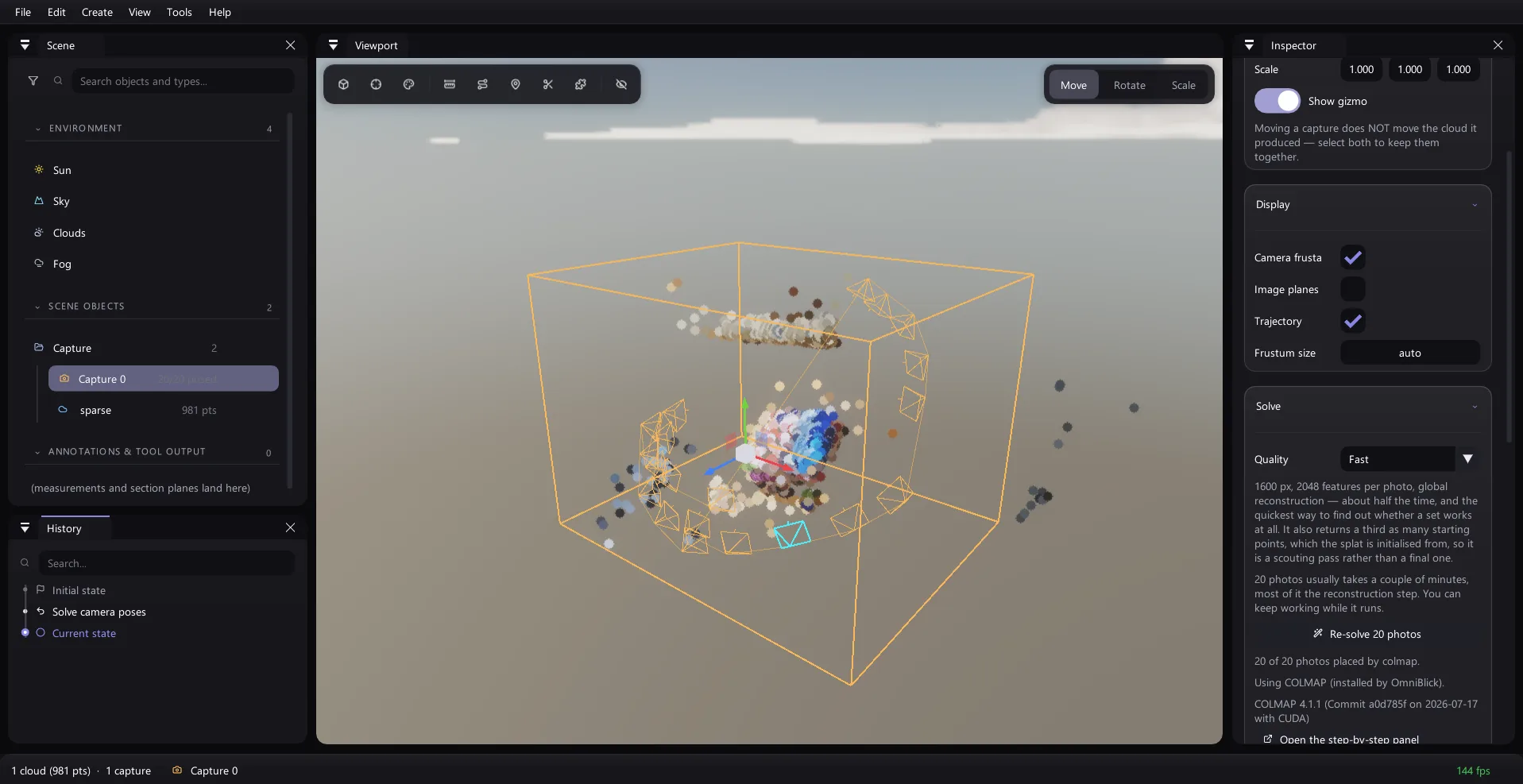
Hundreds of millions of points, at a frame rate you set.
Points are not drawn as geometry here. A compute shader rasterizes them into a 64-bit framebuffer with atomic depth, which removes the fixed-function bottleneck entirely — and a continuous density level of detail thins the workload to a points-per-pixel budget rather than a fixed decimation.
- Colour, intensity and classification preserved from the source, with the coordinate reference system carried through import and export.
- Runs on the async compute queue, overlapped with the frame’s other work rather than queued behind it.
- Esri SLPK and I3S read and written first-party, including per-feature attributes and georeferencing.
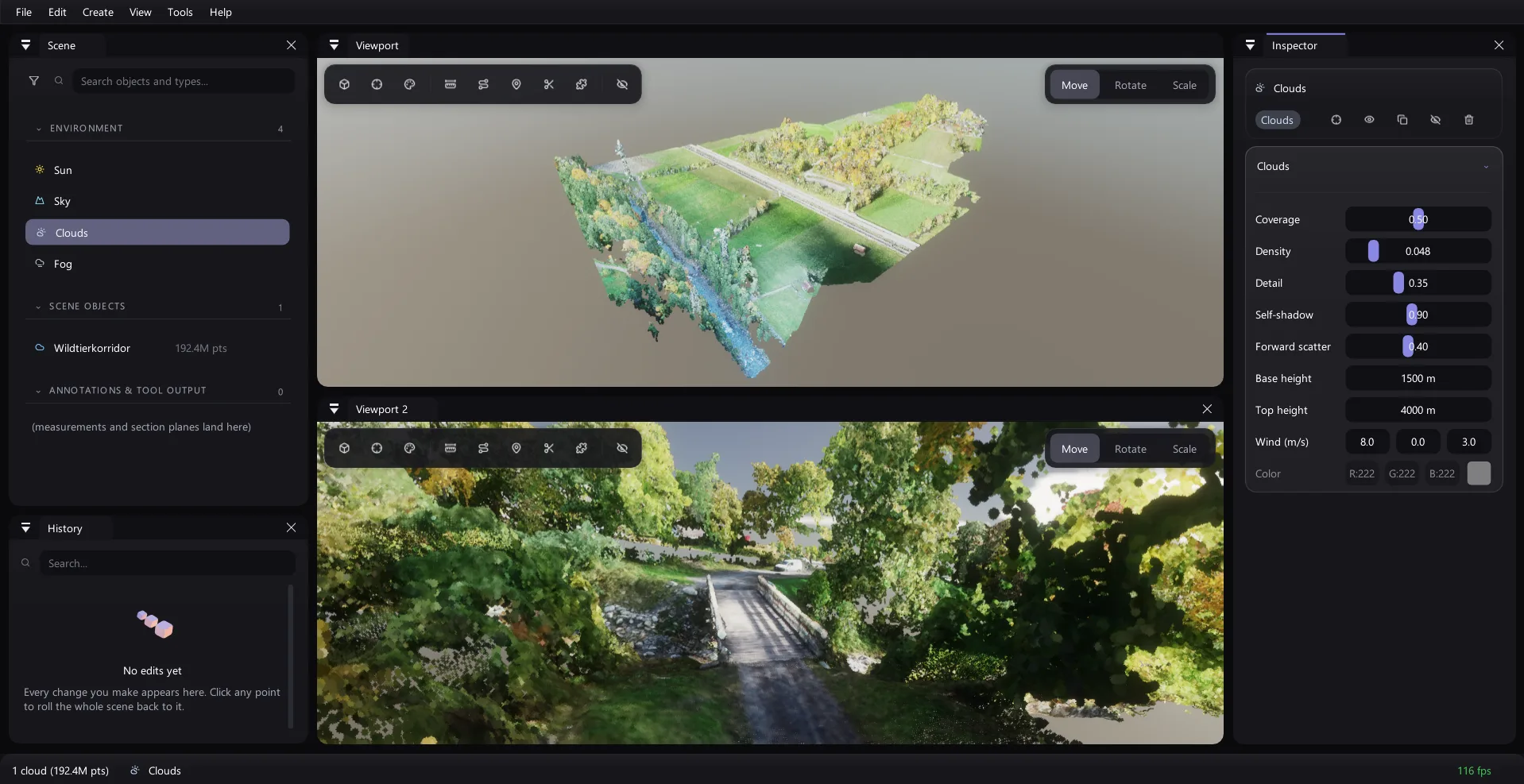
Two eyes, one pass.
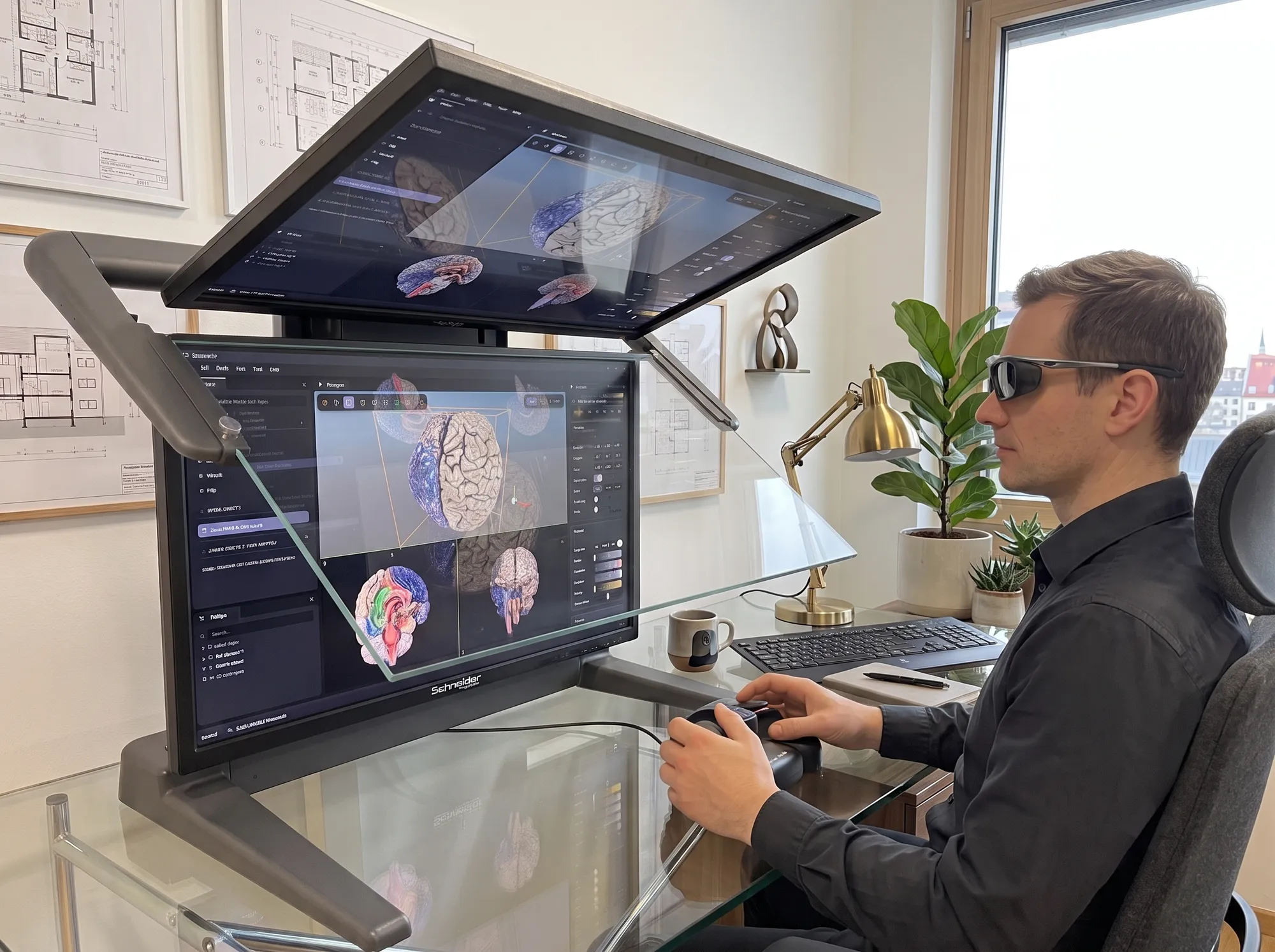
Stereo is a property of the renderer rather than a mode bolted on top of it. Both eyes are produced in a single multiview pass, which is why every optional effect — ambient occlusion, the temporal resolve, volumetric fog, ray-traced reflections — is stereo-correct without any of them being written twice.
- Quad-buffer 3D displays driven natively, plus side-by-side for anything that expects it.
- OpenXR headsets from the same path, switchable without reloading the scene.
- SpaceMouse support with bindings generated from the command registry, so every action you can bind to a key is also bindable to a puck button.
The tools you actually touch all day.
Capability gets a product bought. This is the part that decides whether it gets used.
Measure anything, including a point cloud
Distance, angle and area, snapped to real geometry — and on a virtualized multi-gigabyte mesh the snap tells you honestly when it is working from a simplified copy, rather than quietly being slightly wrong.
Section planes
Cut through a building, name the plane, flip it, drive it with the gizmo or type an exact position. Every plane is an object in the scene with its own visibility and colour.
Undo you can see
The History panel is the undo stack as a timeline — click any point to roll the whole scene back to it. Snapshots are named save points on top of that, taken automatically before anything destructive.
One shortcut for everything
Ctrl+K searches commands, objects, snapshots, recent files and settings at once, with fuzzy matching that learns which commands you actually use.
An Inspector that edits many things at once
Select twelve objects, change the roughness, and it is one undo step — not twelve. Every section resets to its default individually.
Extensible without a fork
Tools are plugins over a documented context: one header, one source file, and it appears in the menus, the palette, the toolbar and the Inspector automatically.
Open your worst file.
The one that takes four minutes to load somewhere else, or does not load at all. The Viewer is free and permanent — you do not need a licence to find out whether this works.
Free Viewer, permanently · 14-day Studio trial, no card · Windows 10/11